I am passionate about designing and modeling innovative, efficient, and sustainable mobility solutions for passengers and freight. I finished my PhD in Transportation Systems Analysis & Planning at Northwestern University, focusing on network design, optimization, and data analytics.
I am also a chartered civil engineer in the United Kingdom with experience in large-scale project management.
I joined Uber Autonomous Mobility & Delivery in San Francisco in 2024, pushing forward optimization and service planning of shared autonomous vehicles.
Shared Autonomous Vehicles (SAVs) enable transit agencies to design more agile and responsive services at lower operating costs. This study designs and evaluates a semi-on-demand hybrid route directional service in the public transit network, offering on-demand flexible route service in lowdensity areas and fixed route service in higher-density areas. We develop analytically tractable cost expressions that capture access, waiting, and riding costs for users, and distance-based operating and time-based vehicle costs for operators. Two formulations are presented for strategic and tactical decisions in flexible route portion, fleet size, headway, and vehicle size optimization, enabling the determination of route types between fixed, hybrid, and flexible routes based on demand, cost, and operational parameters. Analytical results demonstrate that the lower operating costs of SAVs favor more flexible route services. The practical applications and benefits of semi-on-demand feeders are presented with numerical examples and a large-scale case study in the Chicago metropolitan area, USA. Findings reveal scenarios in which flexible route portions serving passengers located further away reduce total costs, particularly user costs, whereas higher demand densities favor more traditional line-based operations. Current cost forecasts suggest smaller vehicles with fully flexible routes are optimal, but operating constraints or higher operating costs would favor larger vehicles with hybrid routes. The study provides an analytical tool to design SAVs as directional services and transit feeders, and tractable continuous approximation formulations for planning and research in transit network design.
@article{ng_semi--demand_2024,title={Semi-on-demand hybrid transit route design with shared autonomous mobility services},volume={185},issn={0968090X},doi={10.1016/j.trc.2026.105578},language={en},urldate={2026-02-20},journal={Transportation Research Part C: Emerging Technologies},author={Ng, Max. T.M. and Dandl, Florian and Mahmassani, Hani S. and Bogenberger, Klaus},month=apr,year={2026},pages={105578},}
Joint optimization of multimodal transit frequency and shared autonomous vehicle fleet size with hybrid metaheuristic and nonlinear programming
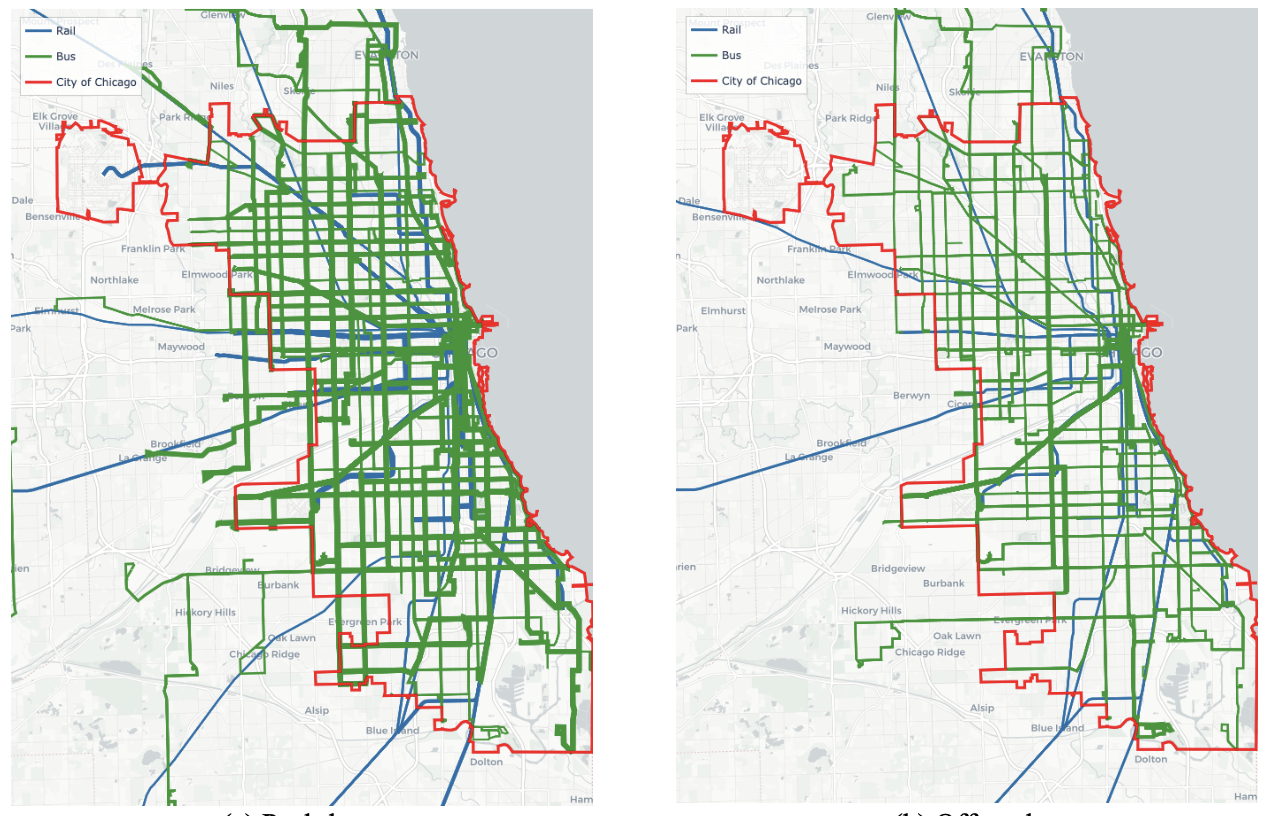
Shared autonomous vehicles (SAVs) bring competition to traditional transit services but redesigning multimodal transit network can utilize SAVs as feeders to enhance service efficiency and coverage. This paper presents an optimization framework for the joint multimodal transit frequency and SAV fleet size problem, a variant of the transit network frequency setting problem. The objective is to maximize total transit ridership (including SAV-fed trips and subtracting boarding rejections) across multiple time periods under budget constraints, considering endogenous mode choice (transit, point-to-point SAVs, driving) and route selection, while allowing for strategic route removal by setting frequencies to zero. Due to the problem’s non-linear, non-convex nature and the computational challenges of large-scale networks, we develop a hybrid solution approach that combines a metaheuristic approach (particle swarm optimization) with nonlinear programming for local solution refinement. To ensure computational tractability, the framework integrates analytical approximation models for SAV waiting times based on fleet utilization, multimodal network assignment for route choice, and multinomial logit mode choice behavior, bypassing the need for computationally intensive simulations within the main optimization loop. Applied to the Chicago metropolitan area’s multimodal network, our method illustrates a 33.3% increase in transit ridership through optimized transit route frequencies and SAV integration, particularly enhancing off-peak service accessibility and strategically reallocating resources.
@article{ng_joint_caspt_2025,title={Joint optimization of multimodal transit frequency and shared autonomous vehicle fleet size with hybrid metaheuristic and nonlinear programming},volume={185},issn={0968-090X},doi={10.1016/j.trc.2026.105568},urldate={2026-02-14},journal={Transportation Research Part C: Emerging Technologies},author={Ng, Max T. M. and Mahmassani, Hani S. and Tong, Draco and Verbas, Ömer and Cokyasar, Taner},month=apr,year={2026},keywords={Shared autonomous vehicles, Particle swarm optimization, Nonlinear programming, Multimodal transit, Transit network frequency setting problem},pages={105568},}
2024
Redesigning large-scale multimodal transit networks with shared autonomous mobility services
This study addresses a large-scale multimodal transit network design problem, with Shared Autonomous Mobility Services (SAMS) as both transit feeders and an origin-to-destination mode. The framework captures spatial demand and modal characteristics, considers intermodal transfers and express services, determines transit infrastructure investment and path flows, and generates transit routes. A system-optimal multimodal transit network is designed with minimum total door-to-door generalized costs of users and operators, satisfying transit origin–destination demand within a pre-set infrastructure budget. Firstly, the geography, demand, and modes in each zone are characterized with continuous approximation. The decisions of network link investment and multimodal path flows in zonal connection optimization are formulated as a minimum-cost multi-commodity network flow (MCNF) problem and solved efficiently with a mixed-integer linear programming (MILP) solver. Subsequently, the route generation problem is solved by expanding the MCNF formulation to minimize intramodal transfers. The model is illustrated through a set of experiments with the Chicago network comprised of 50 zones and seven modes, under three scenarios. The computational results present savings in traveler journey time and operator cost demonstrating the potential benefits of collaboration between multimodal transit systems and SAMS.
@article{ng_redesigning_2023,title={Redesigning large-scale multimodal transit networks with shared autonomous mobility services},issn={0968-090X},doi={10.1016/j.trc.2024.104575},urldate={2024-03-27},journal={Transportation Research Part C: Emerging Technologies},author={Ng, Max T. M. and Mahmassani, Hani S. and Verbas, Ömer and Cokyasar, Taner and Engelhardt, Roman},month=mar,year={2024},keywords={Autonomous vehicles, Multimodal, Network optimization, Shared Autonomous Mobility Services (SAMS), Transit network design},pages={104575},}